

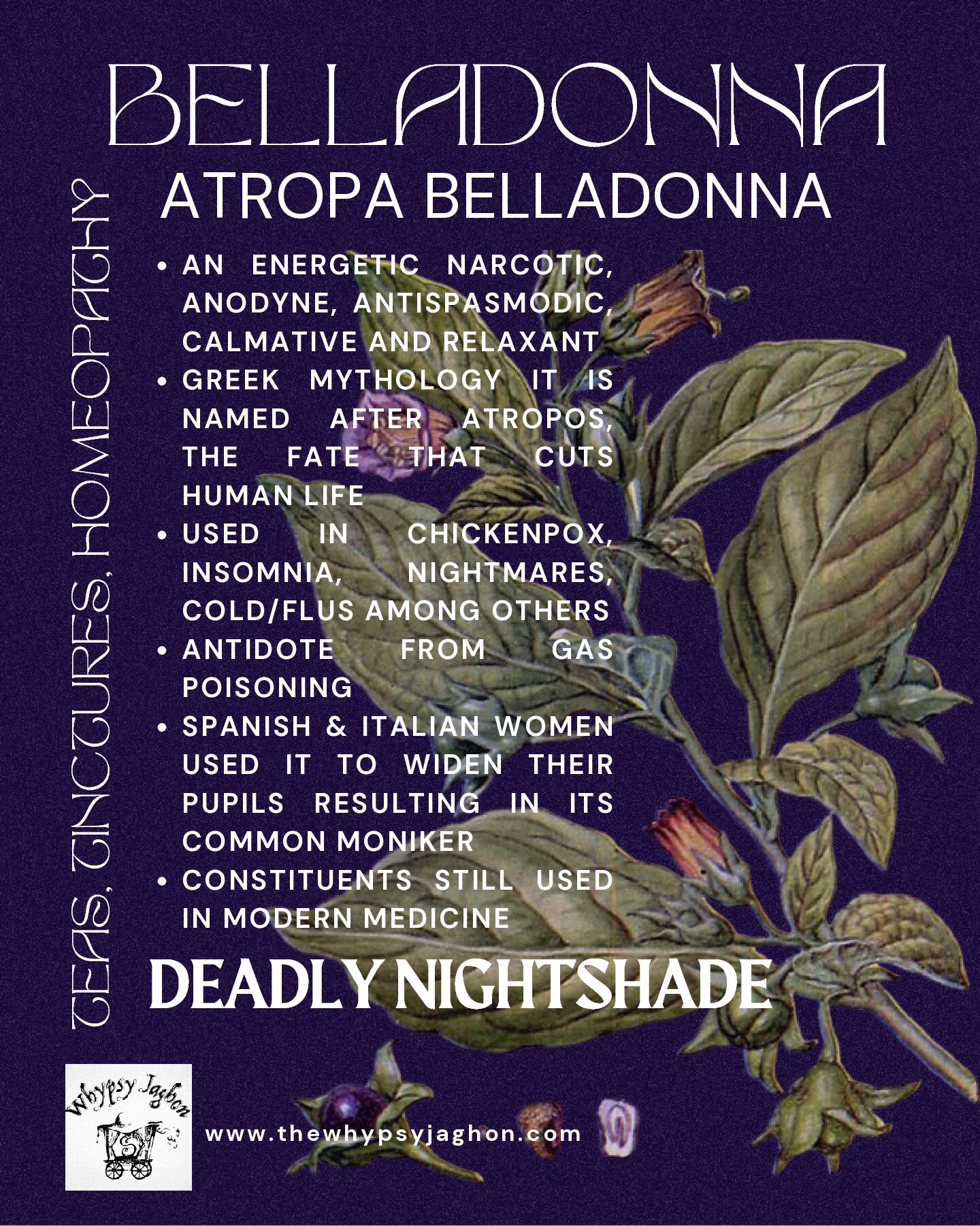
Fatal Beauty: Belladonna
The misunderstood plant with a deadly charm and a rich medicinal past
The fatal beauty that is Belladonna (Atropa belladonna), also known as Dwale, Black Cherry, or more ominously, Deadly Nightshade, is native to Europe, Asia, and North Africa—but nowadays, it pops up all over the world. This member of the Solanaceae family makes its dramatic entrance from May to August, bearing shiny black berries by September.
Belladonna is a powerful plant spirit. It’s narcotic, anodyne, antispasmodic, calmative, and relaxant—basically, an herbal gothic novel wrapped in leafy green. Oh, and it ranks in my top five Stevie Nicks songs, naturally.
Not Your Average Cup of Tea
☠️ Use only with professional guidance
Let’s be clear: Belladonna is not for casual kitchen medicine-making. It’s potent and, in the wrong hands, very dangerous. Still, here’s a historical recipe from Joseph E. Meyer’s The Herbalist (1918), offered for educational insight—not as a DIY.
Steep 1 teaspoon of dried Belladonna leaves in a pint of boiling water.
Take 1–2 teaspoonfuls 2–3 times daily when feeling chilled.
⚠️ Consult a trained herbalist or healthcare provider—this plant can kill.
As Paracelsus once said:
“What is there that is not poison? All things are poison and nothing is without poison. Solely the dose determines that a thing is not a poison.”
Belladonna: A Plant of Fate & Folklore
The genus name Atropa honors Atropos, one of the three Fates in Greek mythology—the one who severs the thread of life. It’s poetic and fitting for a plant with a reputation for both healing and harm.
Throughout history, Belladonna earned mystical status: from warding off cholera and dysentery, to its rumored use in witches’ flying ointments. In wartime, its antispasmodic properties made it useful as an antidote to gas poisoning.
And yes, its name—Belladonna, or “beautiful woman”—comes from the cosmetic trend of 16th-century Spanish and Italian women using its juice to dilate their pupils for a dark, dreamy gaze. Even today, ophthalmologists use atropine (a potent alkaloid in Belladonna) to dilate pupils during eye exams.
From Witches’ Brew to Modern Medicine
Belladonna in homeopathy is a whole different story. Homeopathy works with energetic microdoses, so the plant’s presence is symbolic rather than chemical. Homeopathic Belladonna is often used for:
- Fevers and flushed skin (think chickenpox, colds, and flu)
- Sore throats and throbbing headaches
- Convulsions and croup
- Red, hot earaches
- Nightmares and hallucinations
It’s a gentle nudge for the body to heal itself—not the same as herbal dosing, which uses the whole plant in measurable amounts.
Medicinal Use Today: A Tightrope Walk
Today, Belladonna is most commonly used under professional supervision for:
- Intestinal cramping and colic
- Peptic ulcers
- Parkinson’s disease (to reduce tremors and improve mobility)
In my herbalist’s toolkit, this isn’t one I pull out lightly—but its historical and energetic importance can’t be ignored.
Fatal Beauty: Belladonna Still Holds Power
Belladonna walks the line between healing and harm. Its beauty is captivating; its effects, potent. When handled with respect, it can offer profound support—but never without a trained eye and steady hand.
So while you won’t find me brewing a casual Belladonna tea, I do admire her strength, her shadowy history, and her place in the grand herbal story. A true fatal beauty, indeed.