

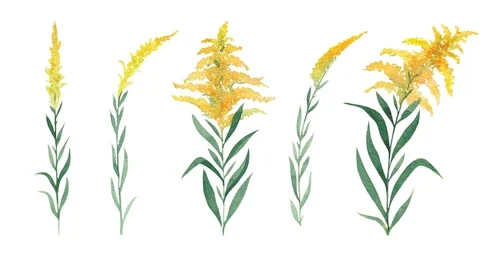
Goldenrod (Solidago spp.)
Goldenrod (Solidago spp.) is a naturalized “native.” This yellow beauty goes by many names: woundwort, Aaron’s rod, blue mountain tea.
It is truly native to Asia and Europe, as so many are, but has since been naturalized here for so long now that it is referred to as a native. Furthermore now, over 130 species of it grow all over the U.S.
Alas, we may have Disney to blame for its relation to allergies, as Sneezy was holding goldenrod during an allergic episode. Sadly, it is ragweed that is to blame for allergy sufferers everywhere. These two plants grow alongside each other at similar times of the year.
Goldenrod is paradoxically used as a treatment for ragweed-induced hayfever. And for that matter, ragweed itself is also used to inoculate sufferers of hayfever when started six months prior to flowering.
Texas Varieties
- Solidago altissima (Tall Goldenrod)
- Solidago odora (Sweet Goldenrod) – known for its anise-scented leaves
- Solidago tortifolia (Twist-Leaf Goldenrod)
- Solidago nitida (Shiny Goldenrod)
- Solidago petiolaris (Downy Ragged Goldenrod)
Leaves and flowers are gathered in late summer, August – September. Always gather from abundant areas and never take all from one plant. Foraging 101.
Main Chemical Constituents
- Saponins – antifungal, specifically against candida
- Diterpenes – immunomodulating (cytokines)
- Phenolic glucosides – antioxidant, anti-inflammatory
- Acetylenes – antifungal, antibacterial
- Cinnamates – pest defense, antimicrobial
- Flavonoids – blood pressure, diabetes, inflammation
- Tannins – bitter, antioxidants
- Hydroxybenzoates – reduces risk of cancer, asthma, allergies
- Inulin – prebiotic fiber, gut health, blood sugar
Herbal Actions
- Antioxidant
- Diuretic
- Astringent
- Diaphoretic
- Stimulant
- Carminative
- Spasms
- Urinary tract inflammation
- Kidney and intestinal inflammation
- Diarrhea
- Fluid retention
History and Folklore
One of my favorite herbalists, John Gerard, mentioned in 1597 that:
“Goldenrod has in times past been had in greater estimation and regard than in these days: for within my remembrance, I have known the dry herb which came from beyond the seas, sold…for half a crown an ounce. But since it was found in Hampstead, wood [London]…no man will give half a crown for an hundredweight of it: which plainly setteth forth our inconstancy and sudden mutability, esteeming no longer of any thing (how precious soever it may be) than whilst it is strange and rare.”
Isn’t that the truth? Once something is found abundantly, it is no longer seen as a delicacy. I guess lobsters never got the memo.
Written in Culpeper’s Complete Herbal:
“Arnoldus de Villa Nova commends it much against the stone in the reins and kidneys, and to provoke urine in abundance, whereby also the gravel and stone may be voided. It stops bleeding in any part of the body and wounds internally and externally. It is a sovereign wound herb, inferior to none, both for the inward and outward hurts; green wounds, old sores and ulcers, are quickly cured therewith.”
Herbalists in folklore have used goldenrod to mask the bitterness of other herbs in medicinal preparations.
While in the mid-13th century, it was often used to cure bladder stones. As recently as the 1890s, goldenrod was featured as a pharmaceutical fluid extract.
Recipe
Decoction
- Mix 1 to 2 teaspoons of dried herb with 8 ounces of water
- Boil the mixture
- Let stand for 2 minutes
- Strain and drink
⚠️ Always consult your physician when starting a new herbal remedy. This herbal ally has abortifacient constituents.